 Maximized
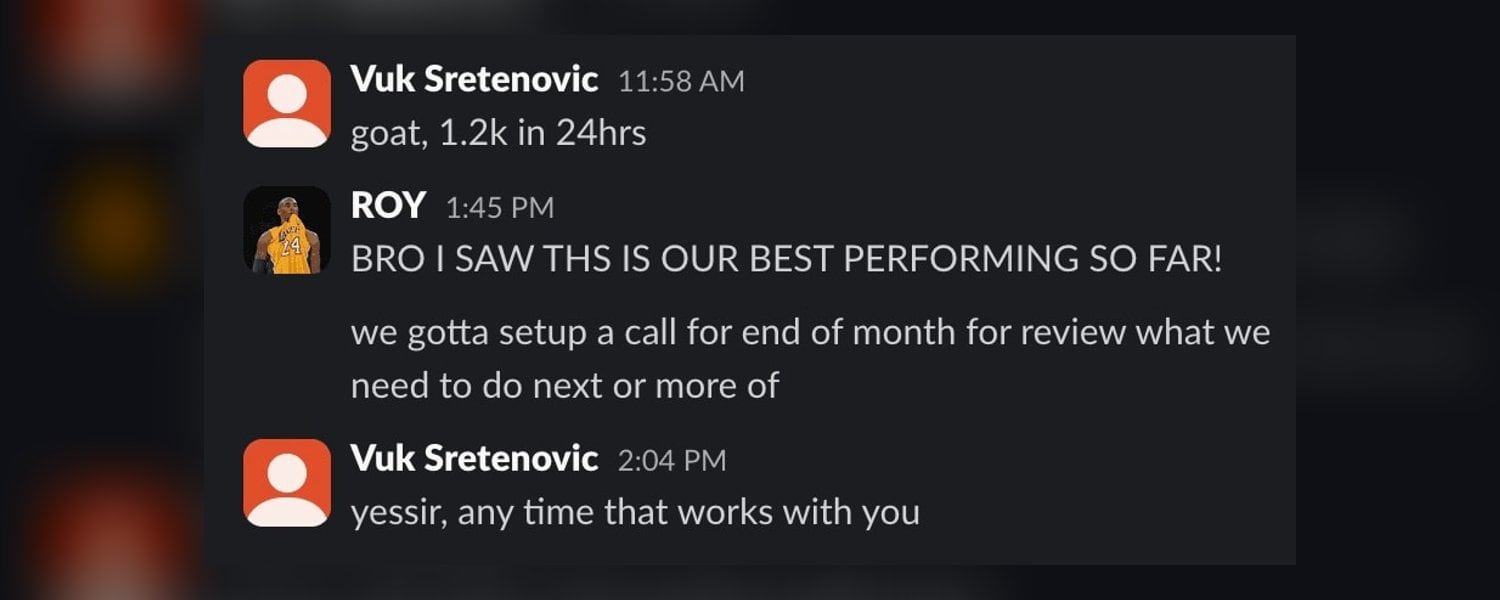
"goat, 1.2k in 24hrs"
That was the whole message I sent Roy. No report, no slide deck, just the number
He wrote back in all caps: "BRO I SAW THS IS OUR BEST PERFORMING SO FAR!" Then he asked for a call so we could go through it together
Look at that number again. 1,200 views in a day. Post that in any YouTube growth group and someone will tell you to change your thumbnail and try again
For Roy, it was the best video his channel had put out up to that point. And Roy is the same client who said this about working with us: "I think we've already closed over $80,000 in cash collected, not revenue… from three videos. So safe to say, very profitable"
His channel has 11.8K subscribers
If you're a coach, consultant or founder doing $50k+ a month, you've probably put YouTube off because you think it only pays once you're big. Roy's story is the best proof I have that it doesn't
So here's all of it: where Roy was, what we changed, what came out of it, the mistakes I see every week, and what to do if you start this week
Where Roy started, and the belief that keeps coaches stuck
Roy is in wholesale real estate. His channel is called ROY, The Closer, and the name tells you what he's good at
He isn't a YouTuber and he doesn't want to be one. He has a business to run. YouTube was supposed to feed that business, not turn into a second job
That's exactly where most people reading this are
And most of them carry the same belief: YouTube is a views game, and it only starts paying once you're big. 100K subscribers, a viral video, a million views on something
I get why people believe it. Almost every YouTube advice video you've watched was made by someone whose business is views. They get paid from ads and sponsors, so of course they measure everything in views
Your business isn't views. It's calls, and the cash that comes out of them
That one belief does damage in two ways. Some coaches never start, because they look at creators with millions of subscribers and decide they're years away. The rest start, post a dozen videos, see 300 views on each, and quietly stop
Every coach has thought about starting a YouTube channel. Almost none of them uploaded 50 videos
Roy thought about it differently, and you can hear it in how he talks about money. He didn't say revenue. He said "cash collected, not revenue"
Revenue is what someone agreed to pay. Cash collected is what actually landed in the account. That's a closer's way of keeping score
He was also tracking every lead that came in from YouTube. He told me that in one of his messages, right next to his notes on the video
Most coaches I get on calls with can't tell me how many calls YouTube booked last month, let alone which video booked them
That difference is where this whole story starts
We kept score in cash collected, not views
Before anything gets filmed, we agree with a client on what a win looks like. With Roy that conversation was short. A win is a lead from YouTube that turns into money
That sounds obvious until you see what it changes
When views are the goal, you pick topics with the biggest audience. When cash is the goal, you pick topics with a buying audience. Those are almost never the same videos
I've seen both sides up close. We worked on a Prince Ea video that hit 1M views. Roy's best video at that point did 1.2k in its first day. Both were wins. They were just different games, and if Roy had judged his channel by Prince Ea's scoreboard, he would have quit long before the $80K
Here's how you keep score the way Roy does
Put one question on your booking form: "Which of my videos did you watch before booking?" Make it a text box, not a dropdown. People remember the topic, not your title, and their own words tell you what landed
Use a booking link that only lives on YouTube, in your descriptions and your pinned comment. Now you can count it without guessing
Once a month, write next to each video how many calls it brought and how much cash came from those calls. After 10 videos you'll see a pattern your analytics will never show you. Usually two or three videos do most of the work, and they're rarely the ones with the most views
We made videos for the person about to buy, not the person scrolling
This is why that 1.2k message mattered so much
1,200 people in a day on a channel about wholesale real estate is not a random crowd. Nobody watches a long video about wholesaling by accident. Those people are in the business, or trying to get into it
Most agencies would look at that number and try to fix it by going broader. Make the topic more general, so more people click
The problem is that broader means the buyer feels less spoken to. You trade the 200 people who might pay you for 20,000 people who never will
On our site we say it in one line: videos built around the questions clients ask before they buy. That's the rule we work from with every coach and consultant, Roy included
I'm not going to tell you to go study your sales calls. You already know what people ask. The part most people miss is that buyers look for three very specific videos in the last week before they pay, and almost nobody makes them:
- The price video: what it costs, what they get, and who it's not for, said straight
- The comparison video: you against the other way of solving it, whether that's doing it alone, a cheaper program or hiring in-house
- The proof video: real numbers from someone who did it, including what went wrong
These videos never go viral. They get a few hundred views
They're also the videos someone watches the night before a call with you, then shows up already sold. Your closer stops explaining and starts onboarding
We edited for trust, not for tricks
Roy sent me another message about a different video. He'd watched it five times. He called it "one of our best videos" and wrote, in capitals, "GIVE THE EDITOR A RAISE!"
In that same message he mentioned he was tracking every YouTube lead. He wasn't excited about the edit because it looked nice. He was excited because he knew what a video like that does to a buyer
Someone watching your 15-minute video is doing the same thing they do on a sales call. They're deciding if they trust you
Every second they stay is another second of a hot lead listening to you. Every second they leave is a call that never gets booked
Here's what most agencies get wrong. They take the editing style from entertainment channels. A zoom every two seconds, a sound effect on every word, a meme cutaway whenever the person on camera takes a breath
That works when the job is keeping a bored teenager from swiping away. For someone deciding whether to spend thousands with you, it makes you look like you're hiding something
I won't break down every cut in Roy's video here, but this is what our editors do on every business channel. Cut the wind-up, so the first sentence is the point. Put the proof on screen the moment you mention it, the deal, the screenshot, the number. Keep the moments where you think out loud, because that's where a buyer decides they like you
And keep the pace close to how you actually talk on a call. If your video sounds nothing like you, the call feels like meeting a stranger
We treated the title and thumbnail as the ad
I posted this a while ago and I still stand by it. Thumbnail designers charging $20 are pricing it like a graphic. It's not a graphic. It's the ad for a video that might make someone $50K
In Roy's case, it's the ad for three videos that brought in over $80K in cash
Packaging is part of what we do on every video we make for a client, and we plan it before the edit, not after. If we can't write a title the buyer would click, the idea isn't ready
Look at a few titles from videos we've worked on for business clients:
"Watch this to never fumble a sales call again" for Cardinal Mason. "This One Thing Doubled Our Show-Up Rate" for Ravi Abuvala. "i made $106k in one day using this sales script." for Eli Sol
None of them are clever. Each one names a problem the buyer already has, or a result they already want. A salesperson reads those titles and thinks "that's me"
That's the whole job of a title on a business channel. Not to get everyone to click. To get the right person to click and feel like you made the video for them
How you do it: write the title and sketch the thumbnail before you film. One image, one idea, readable on a phone. Show the result or the problem, not your logo and not a stock photo of a laptop
We got on a call after every win
Here's the detail I like most from Roy's message
His best video so far had just done 1.2k in a day, and his first move wasn't to celebrate. It was to ask for a review call
That's a closer's instinct. When something works, you find out exactly why, so you can do it again on purpose
Most channels post a video and move straight to the next one. A winner is the most valuable data you'll ever get. It tells you what your buyers want more of, in their own behaviour, not in a survey
On those calls we don't start with views. We look at how long people watched, where they dropped off, which comments sound like buyers ("how do I start", "do you work with people in my situation") and whether calls came in that week
If you want to do this yourself, here's the exact routine I give people. Before your next video, I want you to:
- Open YouTube Studio
- Sort your videos by average view duration, not views
- Watch the top one back and write down what you did differently
- Do that again in the next 3 videos
Your best video is already telling you what to film next. Most people just never ask it
What came out of it
Here are the real numbers, all from Roy's own words and messages
Over $80,000 in cash collected from three videos. Not revenue, cash. In his words: "So safe to say, very profitable"
1.2k views in 24 hours on the video that became the channel's best performer at that point. His reply: "BRO I SAW THS IS OUR BEST PERFORMING SO FAR!"
A video he watched five times and called "one of our best videos", with a request I'm still waiting to pass on in full: "GIVE THE EDITOR A RAISE!"
All of it on a channel that has 11.8K subscribers today
There's no million-view moment in this story. I'm not going to dress it up with one
Think about what else gets you $80K in cash from three pieces of work. An ad campaign stops the day you stop paying. A sales rep needs a salary. A video keeps sitting there, answering the same buyer questions at 2am while you're asleep
That's what people mean when they call YouTube a 24/7 salesperson. Roy just has the receipts
What most people get wrong
They grade a business channel like a creator would. If your video got 400 views and two of those people booked a call, that's a great video. Stop showing your views to people who make money from views
They hire the cheapest editor and the cheapest thumbnail designer they can find, then blame YouTube. You wouldn't let a $20 copywriter write your sales page. Your thumbnail is the first line of your sales page
They edit like entertainment. Flashy cuts get you watched by people who were never going to buy. Clean, confident edits get you trusted by the people who were
They quit at 12. Most coaches stop at 12 videos because the first 12 didn't get views. Roy's results came from three videos built for the right person, not from a viral hit, and that only happens if you're still posting when those three land
They don't track. If you can't say which video booked which call, you'll end up making more of the wrong videos and less of the right ones. Roy tracked every YouTube lead. That's half the reason this story has a number in it
If you start this week
You don't need a team to start doing what worked for Roy. Here's what I'd do in the next seven days:
- Add "Which of my videos did you watch before booking?" to your booking form today, before you film anything
- Pick the price, comparison or proof video, whichever one you've been avoiding the most. That's usually the one your buyers want
- Write the title and sketch the thumbnail first. If a buyer wouldn't click it, change the idea, not just the words
- Record it the way you'd answer the question on a call. Open on the answer, not on "hey guys, welcome back"
- Seven days after it goes live, sort by average view duration, read the comments, check your booking form, and plan the next three around whatever worked
Back to Roy
When I think about Roy's channel, I don't think about the subscriber count. I think about that all-caps message over 1,200 views, and the fact that he wanted a call about it straight away
He never needed YouTube to make him famous. He needed it to bring him people who were ready to buy, and to show him which videos were doing it. That's what three videos and over $80K in cash collected looks like
If you want us to build this for you, DM me "YouTube" and I'll take a look at your channel